Hello, -
On Friday I learned the lives of three significant public figures in theological education have come to a close. Yet their powerful legacies continue. Each one contributed to the formation of ministers, the doctoral training of numerous seminary professors, and the education of American churches. They were each nodes in the ecology of ministry in the United States, exerting influence far beyond the US. This week we remember and appreciate Dr. Craig
Dykstra, Dr. Toni Craven, and Dr. Walter Brueggemann.
Already remembrances are pouring in for each figure. But perhaps the least has been said in the last few days about Dr. Craven. So today, we begin by
remembering her.
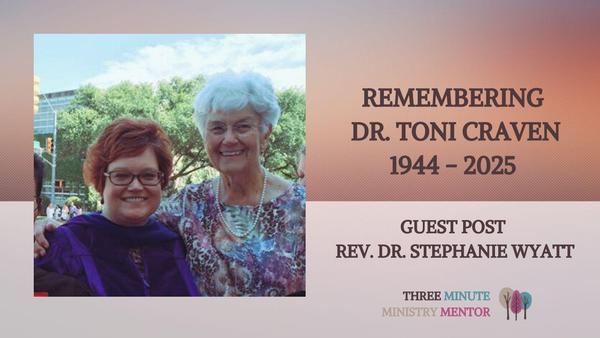
Dr. Toni Craven taught from 1980 until her retirement in 2012 at Brite Divinity School, Texas Christian University in Fort Worth Texas. She taught hundreds of ministers and dozens of
doctoral students. This weekend I invited one of her students, Rev. Dr. Stephanie Wyatt, a friend and minister in Nashville, to write a remembrance of Dr. Craven.
One of the beloved books to which Toni Craven contributed, and which I have consulted many times is Women In Scripture: A Dictionary of Named and Unnamed Women in the Hebrew Bible, the Apocryphal/Deuterocanonical Books, and the New Testament. What a profound gift that book is. If it is not in your library... consider adding it.
Dr. Craven cared deeply about teaching and doing it well. Even more importantly she cared about her learners being able to learn well. She and a colleague, Sherrie Reynolds, wrote a book in which they said:
Teaching based on the belief that learning is emergent is very different from traditional teaching. The belief that learning emerges reverses the traditional view that teaching causes learning. It suggests, instead, that teaching is a response to learning.
Teaching becomes possible when a student encounters a problem, sees a contradiction, or expresses a question. (p. 13)[i]
How right she was. Teaching does not “cause learning.” It is a far more iterative and responsive process between teachers and learners. How would it revolutionize our seminary classrooms if we started from the problems and the questions named by students to set the course for learning each time?
Read Stephanie's remembrance of Dr. Craven here: