Hello, -
I am on a road trip this week. From Nashville we traveled west through the heat
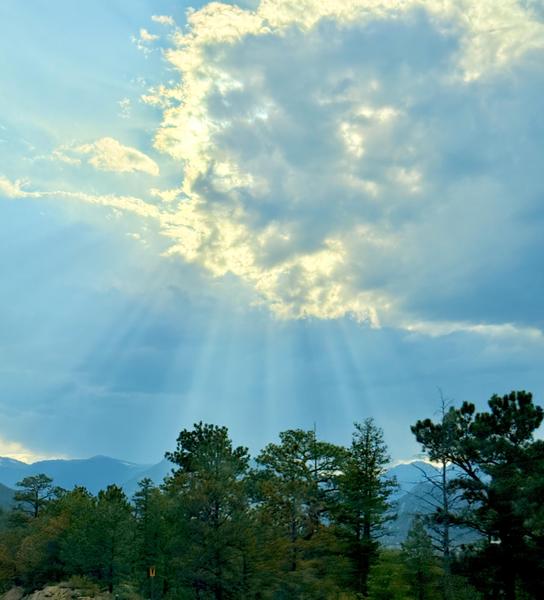
dome. The trip has been punctuated by stops at five minor and major league baseball parks. Play ball! Followed by a few days in Rocky Mountain National Park. What amazing beauty! As I write, we are set for the final leg of our trip to Ring
Lake Ranch.
Along the way I've been reading (and writing) in both traditional paper formats of
book and journal, and digitally on my phone and computer.
I want to tell you about one book I've been revisiting on the long days of riding. Author
Martin Laird is a professor of historical theology at Villanova University, and he is a member of the Order of St. Augustine (OSA), incidentally the same order as Pope Leo. Laird's third book in a series on contemplative prayer is An Ocean of Light: Contemplation, Transformation, and Liberation (Oxford University Press, 2019).
Deepening Practice
If you hold any interest in deepening your practice of prayer, or any contemplative spiritual practice, then I cannot recommend
this series any more highly. The first two books are Into the Silent Land and A Sunlit Absence. Laird's writing throughout the series is lucid, rich, and narratively strong. The greatest power of his books, however, is the wisdom of practice infusing each page, paragraph, and
sentence.
When Laird writes about three doors of contemplation, moving further into the experience of awareness itself, he is not sharing something vague
or theoretical. Rather he is sharing from his own years of personal spiritual experience of praying, decades of teaching hundreds (perhaps thousands) of undergraduates, and centuries of writing from contemplatives, living and dead. He weaves these strands of wisdom into a profoundly beautiful and practical invitation to pray in silence.
Martin Laird charts territory in these books which remains largely hidden, even from many people of faith. The hiddenness is not esoteric, but rather it is part of an open secret. The secret is this: God is not apart from us, but is closer than our very breath, our very being.
Self-Reflection as a Path to the Sacred
When I presented self-reflection as an essential component of ministry practice in
Pastoral Imagination, I was not merely concerned with one’s own awareness of self. (What do I think? How do I feel? Where am I going? Why am I here?) I am suggesting
that self-reflection is key to something much deeper than mere self-awareness for ministry practice or a life of discipleship.
The depth or character of
the awareness that is entailed in self-reflection is a practice of greater awareness, one that goes beyond self-knowledge into a sense of awareness itself. An awareness and participation in holy presence.
This kind of awareness of the sacred presence of God is only available through a disciplined contemplative practice. Honing attention. Releasing distractions. Becoming present to sacred presence when nearly every impulse and fear in our hearts and minds pushes us toward anxiety and avoidance.
We somehow get in our minds that God is absent. Or unavailable to us. That God has left us. Or becomes indifferent to us. However, says Martin Laird, this is not the case.
God does not know how to be absent. This is to say, it would go against God’s nature for God to come and go. But we can be ignorant of this intimate presence and build a life-style that maintains this ignorance. (Sunlit Absence, 18)
Even when we believe in God’s abundant and verdant presence everywhere around us, we can get caught up in so many versions of life that miss and misunderstand sacred reality. For me it goes like this... I overwhelm myself with too much to do. Often, I become a victim of my own feelings. Or I let inherited beliefs distract
and flummox my sense of connection to sacred presence.
How do you tend to forget or ignore sacred connection?
Laird says:
God is too close for our eyes to notice. The problem is not that God is absent but that God is so intimately present. If we are frightened to look within for fear of what we might find there, we will never be at home within ourselves, never at ease in our own skin. If we are not at home within ourselves, we will never realize that we live in the house of [God] in whom there are many dwelling places (Jn 14:2).
(Sunlit Absence, 18-19)
Just as there are a plethora of dwelling places in God’s house, so there are many pathways of contemplative practice that take us to the front porch of God’s luxurious
love.
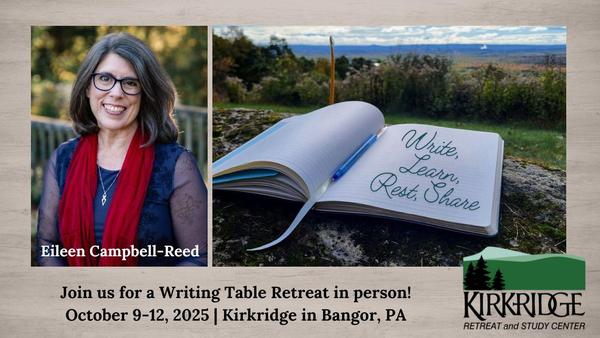
This week at Ring Lake Ranch we will be considering the pathway of writing as a spiritual practice. Writing can be many things: technical, pragmatic, illusory, entertaining.
Yet it is also possible that writing can be a contemplative practice that opens us to the house in which we already dwell. A house of God’s love, a union of presence and awareness, a place where word and silence dwell deeply and peacefully together.